Hey there! I’m a supplier of aerobic aeration products, and I’m stoked to share with you the different types of these products that are out there. Aerobic aeration is super important in a bunch of industries, from wastewater treatment to aquaculture. It helps keep the oxygen levels up and supports the growth of beneficial microorganisms. So, let’s dive in and take a closer look at the various types of aerobic aeration products available. Aerobic Aeration Products

Diffused Aeration Systems
One of the most common types of aerobic aeration products is the diffused aeration system. These systems work by releasing air through diffusers that are placed at the bottom of a tank or a pond. The air bubbles rise to the surface, creating oxygen transfer and mixing in the water.
There are several types of diffusers that can be used in diffused aeration systems. Fine bubble diffusers are really popular because they can produce small bubbles that have a large surface area. This means more oxygen can be transferred from the air to the water. They’re often made of materials like rubber or ceramic.
On the other hand, coarse bubble diffusers create larger bubbles. They’re less efficient in terms of oxygen transfer compared to fine bubble diffusers, but they’re more durable and less prone to clogging. They’re a good choice when the water has a lot of solids or debris.
Diffused aeration systems are great for wastewater treatment plants. They can help break down organic matter in the water by providing oxygen to the bacteria that do the job. They’re also used in aquaculture to keep the fish in a healthy environment by maintaining good oxygen levels in the water.
Surface Aerators
Surface aerators are another type of aerobic aeration product. As the name suggests, they work on the surface of the water. These aerators usually have a motor that drives a propeller or a paddle wheel. When the propeller or paddle wheel rotates, it splashes water into the air, creating a large surface area for oxygen to enter the water.
Surface aerators come in different sizes and designs. Some are floating, which makes them easy to install and move around in a pond or a tank. Others are fixed, which are better for larger bodies of water.
The advantage of surface aerators is that they can provide a high level of oxygen transfer in a relatively short time. They’re also good at mixing the water, which helps distribute the oxygen evenly. They’re often used in small to medium – sized wastewater treatment facilities and aquaculture ponds where quick oxygenation is needed.
Mechanical Aerators
Mechanical aerators are a bit more complex than surface aerators. They use mechanical devices to create turbulence in the water, which in turn promotes oxygen transfer. There are several types of mechanical aerators, such as turbine aerators and brush aerators.
Turbine aerators use a turbine to draw in air and mix it with the water. They can be very effective at oxygenating large volumes of water. They’re often used in large wastewater treatment plants and industrial applications where a lot of oxygen is needed.
Brush aerators, on the other hand, use brushes that rotate in the water. The rotation of the brushes creates a lot of splashing and mixing, which helps oxygen enter the water. They’re commonly used in oxidation ditches, which are a type of wastewater treatment system.
Aeration Blowers
Aeration blowers are essential components in many aerobic aeration systems. They’re responsible for supplying the air that is needed for aeration. There are different types of aeration blowers, including positive displacement blowers and centrifugal blowers.
Positive displacement blowers work by trapping a fixed amount of air and then forcing it into the system. They can provide a constant flow of air, regardless of the pressure in the system. They’re often used in diffused aeration systems because they can deliver the air at a relatively low pressure.
Centrifugal blowers, on the other hand, use a spinning impeller to accelerate the air and then force it out. They can provide a large volume of air at a high pressure. They’re commonly used in large – scale applications where a lot of air is needed, such as in big wastewater treatment plants.
Oxygenation Membranes
Oxygenation membranes are a newer type of aerobic aeration product. These membranes are made of a special material that allows oxygen to pass through but keeps the water out. They can be placed in a tank or a pond, and oxygen is supplied to one side of the membrane. The oxygen then diffuses through the membrane into the water.
The advantage of oxygenation membranes is that they can provide a very high level of oxygen transfer with minimal mixing. This is important in some applications where you don’t want to disrupt the settling process or the growth of certain microorganisms. They’re also more energy – efficient compared to some other aeration methods.
Factors to Consider When Choosing Aerobic Aeration Products
When you’re choosing an aerobic aeration product, there are several factors you need to consider. First of all, you need to think about the size of the area you need to aerate. If you have a small pond or a tank, a surface aerator or a small – scale diffused aeration system might be enough. But if you have a large wastewater treatment plant, you’ll probably need a more powerful system like a turbine aerator or a large – scale diffused aeration system with a big aeration blower.
Another factor to consider is the quality of the water. If the water has a lot of solids or debris, you might want to choose a coarse bubble diffuser or a more durable aeration product. If the water is relatively clean, a fine bubble diffuser or an oxygenation membrane could be a good choice.
You also need to think about energy efficiency. Some aeration products use more energy than others. For example, centrifugal blowers can be more energy – intensive than positive displacement blowers. So, if energy costs are a concern for you, you should choose an aeration product that is more energy – efficient.
Why Choose Our Aerobic Aeration Products
As a supplier of aerobic aeration products, I can tell you that our products are top – notch. We offer a wide range of diffused aeration systems, surface aerators, mechanical aerators, aeration blowers, and oxygenation membranes. Our products are made of high – quality materials, so they’re durable and long – lasting.
We also pay a lot of attention to energy efficiency. We know that energy costs are a big deal for our customers, so we’ve designed our products to use as little energy as possible while still providing excellent oxygen transfer.
Our team of experts is always ready to help you choose the right aerobic aeration product for your needs. We can provide you with technical support and advice on installation and maintenance.
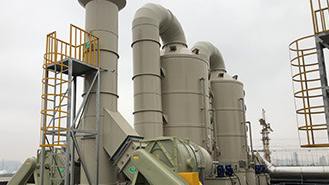
Spray Tower If you’re in the market for aerobic aeration products, I encourage you to get in touch with us. Whether you’re running a small aquaculture operation or a large wastewater treatment plant, we have the products and the expertise to meet your needs. Let’s start a conversation and see how we can help you improve your aeration system.
References
- Metcalf & Eddy. Wastewater Engineering: Treatment and Resource Recovery.
- Tchobanoglous, G.; Burton, F. L.; Stensel, H. D. Wastewater Engineering: Treatment, Disposal, and Reuse.
- Pillay, T. V. R.; Kutty, M. N. Aquaculture: Principles and Practices.
Jinan Guangbo Environmental Protection Technology Co., Ltd.
We’re well-known as one of the leading aerobic aeration products manufacturers and suppliers in China. With a professional production team, we are able to meet the needs of the majority of our customers. Please feel free to buy high quality aerobic aeration products from our factory.
Address: No. 102, Commercial and Residential Building, 18th Floor, Tangye Academician Valley, Tangye Sub-district, Licheng District, Jinan City
E-mail: info@gbwwt.com
WebSite: https://www.gbwwt.com/
